
Technology is moving from a collection of useful tools toward an interconnected ecosystem that can influence how people work, communicate, travel, shop, and solve complex problems. In 2026, artificial intelligence remains one of the biggest forces behind this transformation, while robotics, quantum computing, cybersecurity, cloud infrastructure, and sustainable technology are expanding the boundaries of what digital systems can accomplish. Current technology developments increasingly focus not only on faster devices but also on intelligent systems capable of making decisions, adapting to changing conditions, and working alongside people. Recent industry outlooks point toward stronger adoption of AI agents, AI-ready infrastructure, cybersecurity automation, quantum technologies, and sustainable computing.
For readers following the latest technology news newsreverse com developments, understanding these trends is important because many innovations that once seemed experimental are gradually moving toward practical applications. Businesses are investing in infrastructure that can support intelligent applications, while researchers continue working on technologies that could influence industries for decades.
Artificial Intelligence Is Becoming More Action-Oriented
Artificial intelligence is entering a new phase. Instead of simply responding to individual questions or generating content, newer AI systems are increasingly designed to complete sequences of tasks, connect with software tools, analyze information, and support business workflows. This movement toward agentic AI is one of the most closely watched technology developments of 2026.
AI is also becoming more specialized. Organizations are looking beyond general-purpose models and exploring systems designed for particular industries, datasets, and business processes. This can make AI more useful because specialized systems can be aligned with specific objectives rather than attempting to handle every possible task.
The next stage of AI adoption will therefore depend on more than model performance. Companies also need reliable data, governance, security, human oversight, and clear methods for measuring business value. Industry research increasingly highlights these practical considerations as organizations move from AI experimentation toward wider deployment.
How AI Could Change Everyday Work
AI can increasingly assist with activities such as:
- Research and information analysis
- Software development and testing
- Customer support
- Business forecasting
- Document processing
- Personalized digital experiences
The biggest change may be the shift from people using AI as a simple assistant to people managing AI-supported workflows.
Robotics Is Moving Beyond Traditional Automation
Robotics is another major trend shaping the technology landscape. Industrial robots have been used for years, but advances in sensors, computer vision, machine learning, and edge computing are making robots more adaptable.
Modern robotic systems are being developed to operate in environments where conditions are not perfectly predictable. Improved tactile sensing is particularly important because robots need to understand pressure, movement, grip, and contact when handling delicate objects. New electronic-skin technologies demonstrate how robotics research is moving toward machines that can respond to touch with much greater precision.
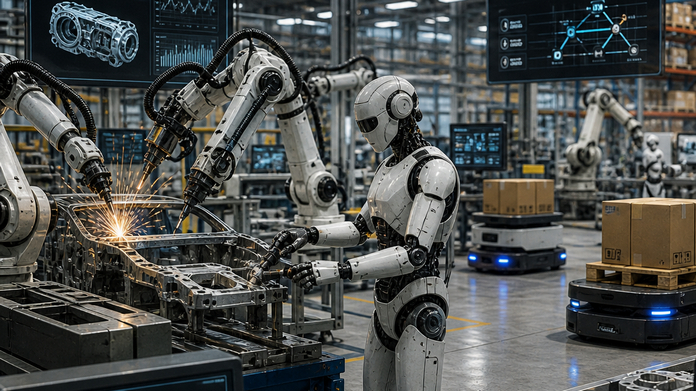
This development could have applications across manufacturing, logistics, healthcare, agriculture, warehouses, and domestic assistance. Instead of replacing every human activity, future robots may increasingly perform repetitive or physically demanding tasks while humans remain responsible for supervision, judgment, and complex decisions.
Quantum Computing Is Gaining Commercial Attention
Quantum computing continues to attract significant interest because it approaches computation differently from conventional machines. Rather than replacing everyday computers, quantum systems are being developed for specialized problems involving optimization, simulation, chemistry, materials, and other computationally demanding tasks.
Commercial interest is also increasing. Recent reporting indicates that businesses are beginning to invest more directly in quantum technology, including applications related to financial modeling, risk analysis, logistics, and cybersecurity.
For the average consumer, practical quantum computing may still appear distant. However, its influence could become significant if researchers overcome major challenges involving scalability, error correction, and reliable hardware. The technology also creates an important cybersecurity issue because sufficiently powerful quantum computers could threaten some existing encryption methods.
Cybersecurity Is Becoming an AI-Powered Battle
As technology becomes more intelligent, digital threats are becoming more sophisticated. Cybercriminals can use automation and AI to accelerate reconnaissance, identify vulnerabilities, and create more convincing attacks. This means traditional security methods increasingly need to operate alongside automated detection and response systems.
Organizations are consequently investing in AI-supported security tools that can identify unusual behavior, prioritize threats, and respond faster. The objective is not simply to build stronger barriers but to create security environments capable of adapting as threats change.
For individuals, the same trend reinforces the importance of basic digital security practices. Strong passwords, multi-factor authentication, software updates, careful handling of suspicious messages, and secure backups remain important even as security technology becomes more advanced.
Cloud and Edge Computing Are Working Together
Cloud computing continues to provide the infrastructure required for large-scale digital services, but edge computing is becoming increasingly important for applications that need rapid responses.
Instead of sending every piece of information to a distant data center, edge systems can process selected data closer to where it is generated. This can reduce delays and help applications operate more efficiently.
Smart factories, connected vehicles, healthcare equipment, surveillance systems, and industrial sensors can all benefit from local processing. At the same time, cloud platforms remain valuable for large-scale storage, model training, centralized management, and complex analytics.
This combination creates a hybrid technology environment where computing resources are distributed across cloud platforms, local devices, and specialized infrastructure.
Sustainable Technology Is Becoming a Business Priority
Technology growth requires substantial computing power, electricity, hardware, cooling systems, and data-center infrastructure. As AI adoption expands, businesses are paying greater attention to the environmental and financial cost of digital infrastructure.
Sustainable technology therefore extends beyond renewable energy. It includes efficient processors, optimized software, responsible data-center design, improved cooling, hardware recycling, and smarter resource management.
The future of digital infrastructure will increasingly depend on doing more computation with fewer resources. Energy-efficient technology can reduce operational costs while helping organizations address environmental concerns.
Connectivity Will Support More Intelligent Systems
Connectivity is also evolving as more devices become capable of communicating and exchanging information. Faster networks, connected sensors, smart appliances, autonomous machines, and industrial IoT systems are creating environments where physical and digital technologies interact continuously.
This connectivity can make transportation systems more responsive, factories more automated, and homes more intelligent. However, it also creates additional security and privacy challenges because every connected device can potentially become part of a larger digital network.
The future will therefore require connectivity that is not only fast but also reliable, secure, scalable, and energy efficient.
Technology Trends at a Glance
| Technology Trend | Main Development | Potential Impact |
|---|---|---|
| Artificial Intelligence | Agentic and specialized AI | Smarter automation and decision support |
| Robotics | Better vision and tactile sensing | More adaptable machines |
| Quantum Computing | Advanced specialized computation | New approaches to complex problems |
| Cybersecurity | AI-assisted defense | Faster threat detection |
| Edge Computing | Local data processing | Lower latency and faster responses |
| Sustainable Technology | Efficient infrastructure | Reduced energy and resource consumption |
| Connected Systems | More intelligent devices | Smarter homes, factories, and cities |
The Future Will Depend on Technology Convergence
One of the most important developments is not a single technology but the way different technologies are beginning to work together. AI can provide intelligence to robots. Edge computing can give connected machines faster decision-making capabilities. Quantum research could eventually contribute to optimization and scientific discovery. Cybersecurity technologies are being developed to protect increasingly automated environments.

Drones provide a useful example of this convergence. Recent developments combine AI, advanced batteries, quantum-related research, sensors, and autonomous systems to create increasingly capable unmanned platforms.
This convergence means future innovation may come from combining existing technologies in new ways rather than inventing an entirely new technology from scratch.
What These Trends Mean for Businesses and Consumers
Businesses will need to think carefully about technology investments. Purchasing the newest system is not automatically the best strategy. Organizations should evaluate whether a technology solves a genuine problem, improves productivity, strengthens security, or creates measurable value.
Consumers will also experience these changes gradually. AI assistants may become more capable, connected devices may become more useful, and intelligent automation could appear in everyday services. At the same time, users will need greater awareness of privacy, security, misinformation, and responsible technology use.
For anyone tracking the latest technology news newsreverse com coverage, the most useful approach is to look beyond exciting product announcements and examine how innovations are moving from demonstrations into practical applications.
Preparing for the Technology Future
Technology careers are changing alongside the tools themselves. Technical knowledge remains valuable, but adaptability, analytical thinking, creativity, communication, and the ability to work effectively with AI are becoming increasingly important. Recent industry commentary similarly emphasizes adaptability as a critical skill as automation changes traditional technology roles.
Professionals can prepare by developing both technical and human skills. Learning about AI, cybersecurity, cloud systems, data, automation, and emerging technologies can create a stronger foundation. At the same time, critical thinking and problem-solving help people determine when technology should—and should not—be used.
The goal should not be to chase every new trend. Instead, individuals and businesses should understand which developments are likely to create lasting value.
Conclusion
The future of technology is being shaped by a combination of intelligence, automation, connectivity, security, and computational power. Artificial intelligence is becoming more capable, robotics is becoming more responsive, quantum computing is attracting greater commercial attention, and cybersecurity is adapting to increasingly sophisticated digital threats. Meanwhile, cloud, edge computing, connected systems, and sustainable infrastructure are creating the foundation needed to support this transformation.
For readers following the latest technology news newsreverse com trends, the central lesson is that the technology future will not be defined by one breakthrough alone. The most significant changes are likely to emerge when several technologies converge and solve real-world problems together. Businesses that invest thoughtfully and people who continue developing adaptable skills will be better prepared for an environment where innovation is no longer occasional—it is continuous.